

GST Update
Desk of CA. Praveen Sharma – 894 Series (CAPS)
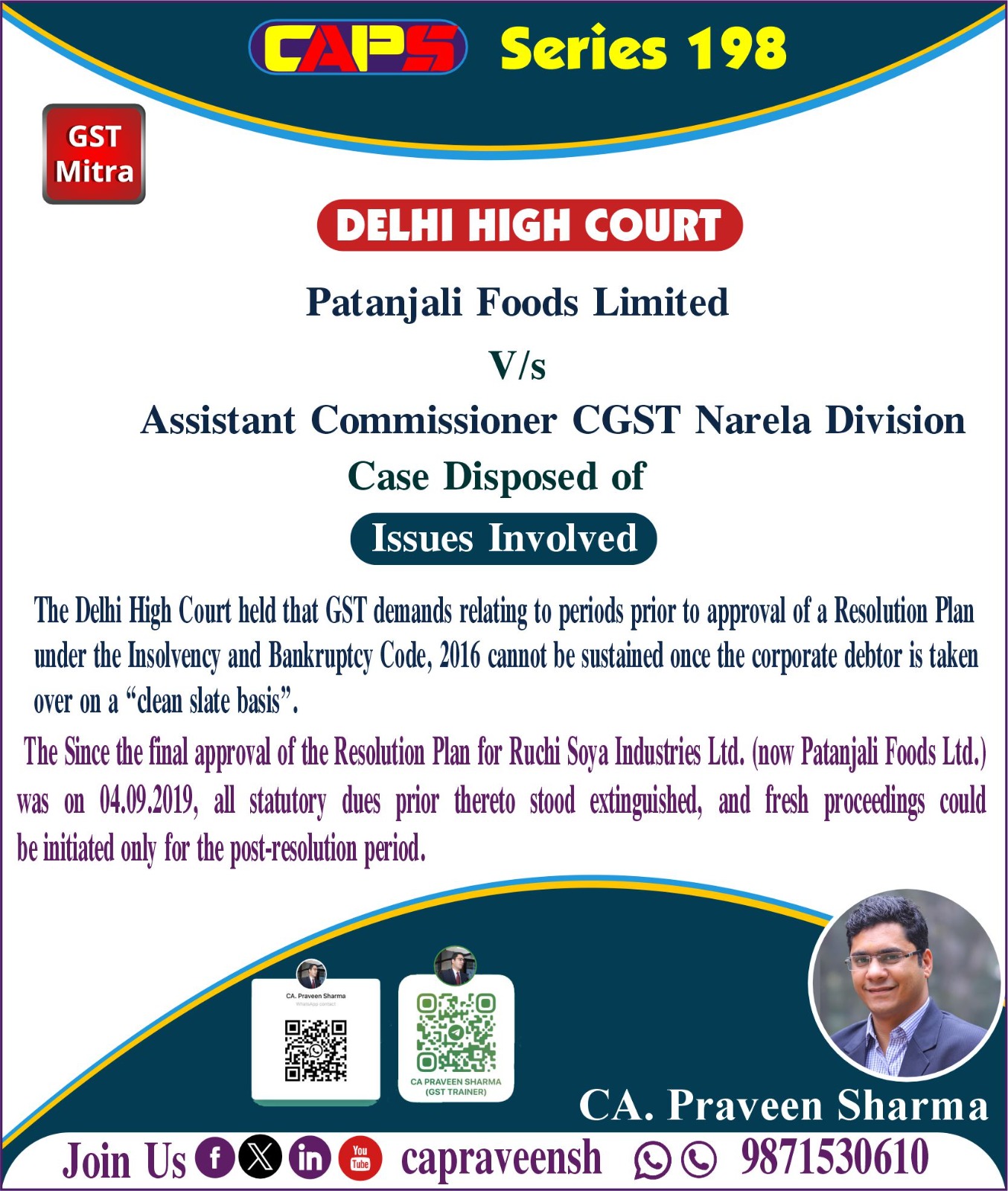
The Delhi High Court recently decided a significant GST matter involving Patanjali Foods Limited.
Patanjali Foods Limited filed a writ petition challenging a GST adjudication order and a corrigendum issued for FY 2017–18, which created tax demands against the company.
The background of the case lies in the insolvency of Ruchi Soya Industries Ltd. Patanjali-led consortium acquired Ruchi Soya as a going concern under a resolution plan approved by the NCLT.
The resolution plan was approved on a “clean slate” basis. This meant that all past liabilities and claims that were not part of the resolution plan stood extinguished after approval.
Despite this, GST audits and proceedings were initiated later, resulting in tax demands for periods both before and after the approval of the resolution plan.
Patanjali contended that GST demands for periods prior to the resolution plan could not survive, as settled Supreme Court law clearly provides that once a resolution plan is approved, all earlier unclaimed dues are wiped out.
A crucial issue before the Court was identifying the correct date of approval of the resolution plan. The department argued that approval took place on 24 July 2019, while Patanjali contended that final approval was only on 4 September 2019.
After examining NCLT orders, previous High Court judgments, and earlier decisions involving the same company, the Delhi High Court held that the resolution plan attained final approval only on 4 September 2019.
As a result, all GST demands relating to periods prior to 4 September 2019 were held to be legally unsustainable and were quashed.
The Court clarified that the GST authorities are free to initiate fresh proceedings only for periods after 4 September 2019. It was also directed that the time during which the writ petition remained pending would be excluded while computing limitation.
LINK: CA. Praveen Sharma on Linkedin
Regards
CAPS
0 Comments: