

GST Update
Desk of CA. Praveen Sharma – 950 Series (CAPS)
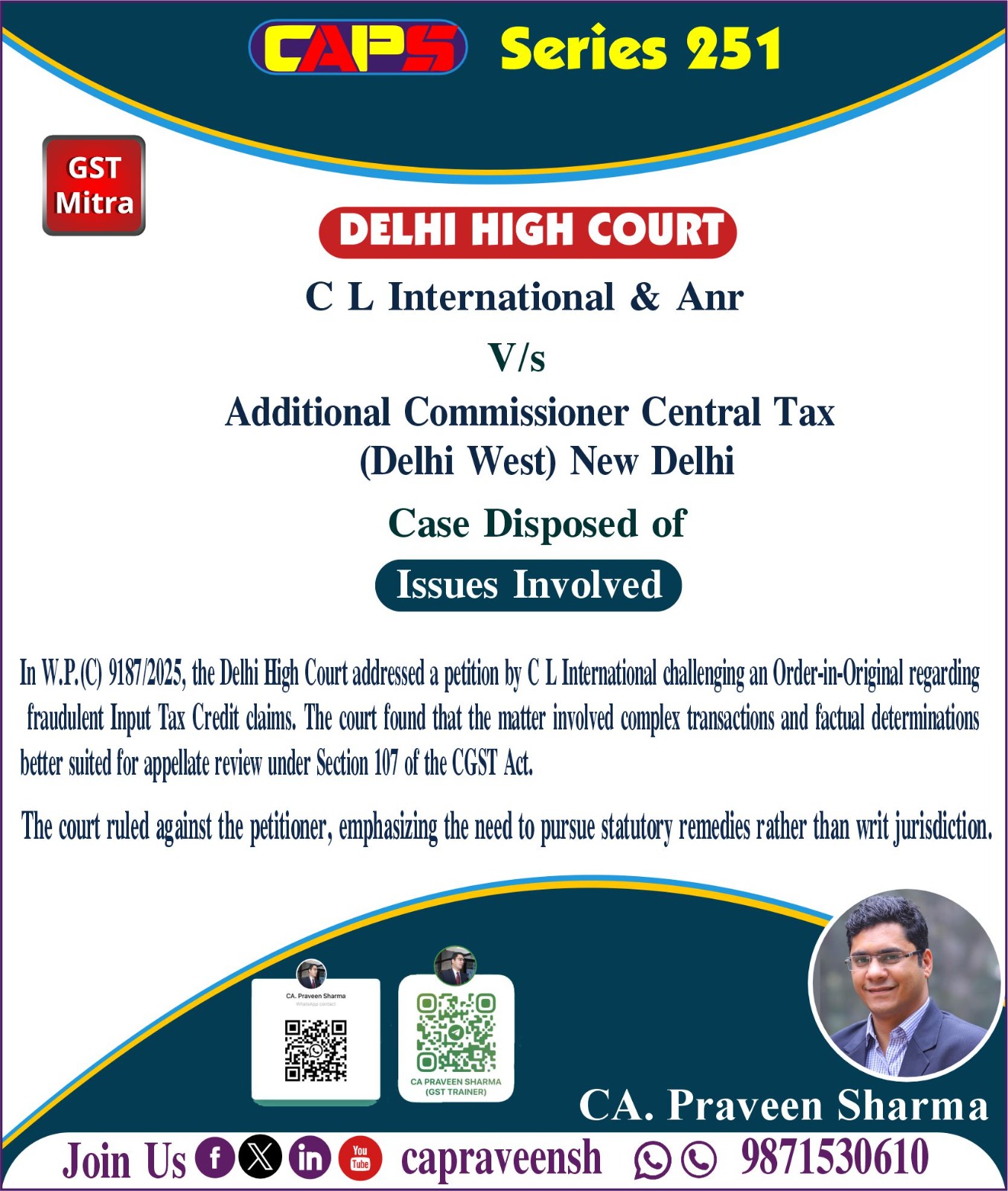
Delhi High Court in the case of C L International & Anr
The Delhi High Court recently dealt with a writ petition filed by the petitioner challenging the Order-in-Original dated 31 January 2025 passed by the Commissioner, Central Tax (Delhi West), along with the Show Cause Notice dated 2 August 2024. The matter was heard in hybrid mode, allowing both physical and virtual participation.
The dispute arose after the GST Intelligence Department gathered information regarding alleged fraudulent availment of Input Tax Credit (ITC). According to the department, the petitioner and certain connected entities were involved in transactions based on fake invoices without any actual supply of goods. The authorities alleged that several firms linked with the case were non-existing or non-functional and were created only to generate bogus invoices for claiming inadmissible ITC.
During the proceedings, the petitioner raised certain grievances before the Court. It was argued that the relied-upon documents had not been properly supplied by the department and that the adjudicating authority had failed to adequately consider the reply submitted against the Show Cause Notice. The petitioner therefore sought relief by challenging the order through a writ petition.
However, the High Court observed that the case involved detailed factual issues concerning multiple entities, financial transactions, promoters, and related records. Such matters, according to the Court, require thorough examination of evidence and documents. The Court noted that writ jurisdiction under Article 226 is generally not exercised where complex questions of fact are involved.
The Court further observed that the impugned order passed by the adjudicating authority is appealable under the statutory provisions of the GST law. Since an effective alternative remedy of appeal is available, the petitioner should approach the appellate authority rather than directly invoking writ jurisdiction.
The Court reiterated an important principle that in cases involving allegations of fraudulent ITC claims and complex financial dealings, the proper course is to pursue the statutory appellate remedy where evidence can be examined in detail. Writ courts typically avoid adjudicating such disputes unless there is a clear violation of natural justice or lack of jurisdiction.
Accordingly, the writ petition was disposed of with liberty granted to the petitioner to file an appeal before the appropriate appellate authority by 1 February 2026 after making the required pre-deposit. The Court further directed that if the appeal is filed within this time, it shall not be dismissed on the ground of limitation and must be decided on merits.
This decision highlights the consistent approach of High Courts in GST matters where disputed facts and allegations of fraudulent ITC are involved. Taxpayers are generally expected to first exhaust the statutory appellate remedy before approaching writ courts.
LINK: CA. Praveen Sharma on Linkedin
Regards
CAPS
0 Comments: