

GST Update
Desk of CA. Praveen Sharma – 948 Series (CAPS)
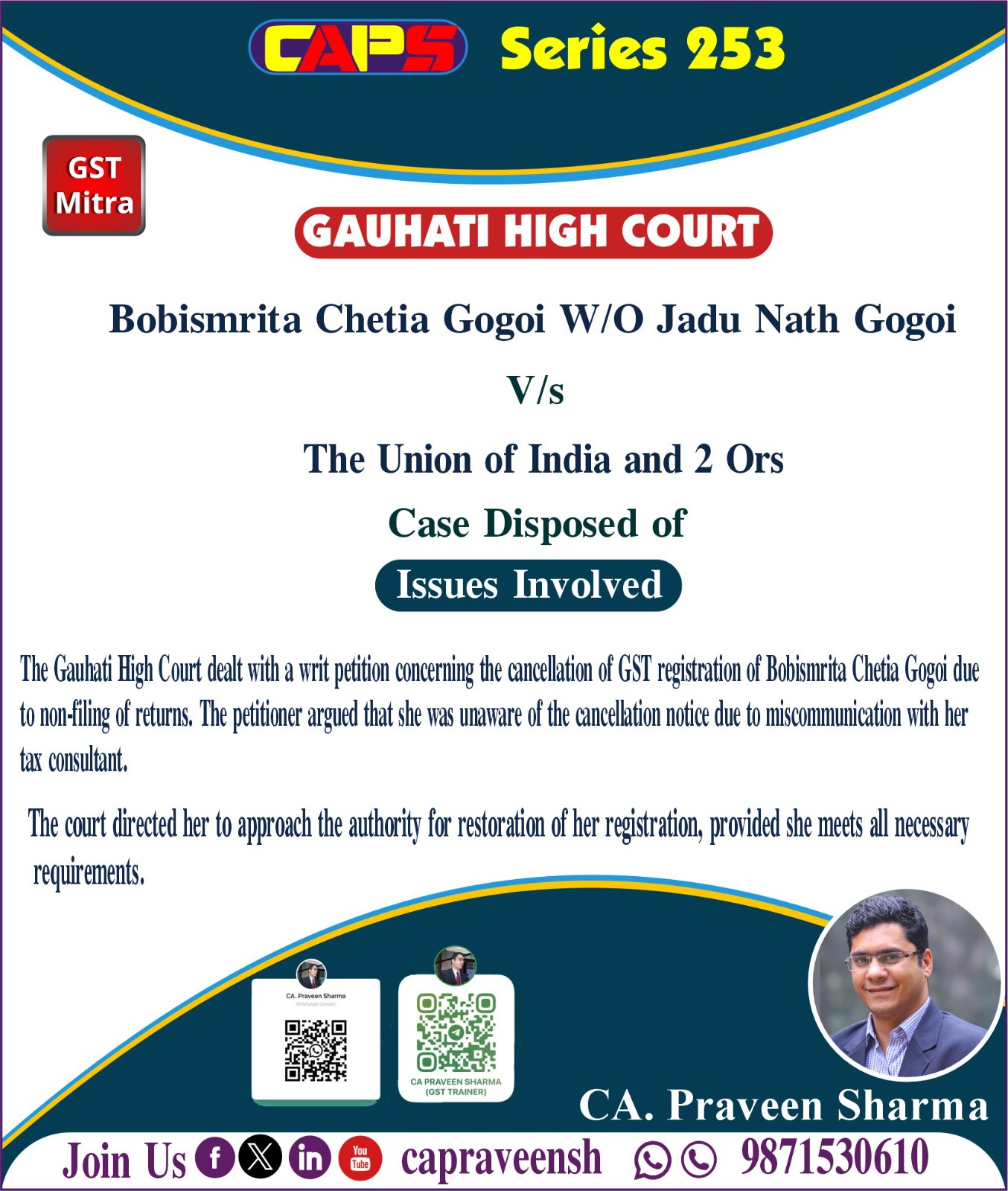
The Gauhati High Court recently dealt with a case concerning cancellation of GST registration due to non-filing of returns. The petitioner, Bobismrita Chetia Gogoi, sole proprietor of M/s Poly Enterprise, was registered under the CGST and AGST Acts. Her GST registration was cancelled through an order dated 11 November 2024 after she failed to file GST returns for six consecutive months. The cancellation followed a show cause notice issued on 7 October 2024.
The petitioner submitted before the Court that the failure to respond to the show cause notice was due to miscommunication with her tax consultant. As a result, she remained unaware of the notice and could not file a reply within the prescribed time. By the time she came to know about the issue, the cancellation order had already been uploaded on the GST portal.
Subsequently, the petitioner took corrective steps and filed all pending GST returns up to November 2024. She also cleared the entire tax liability along with applicable interest and late fees.
However, when she attempted to apply for revocation of cancellation through the GST portal, the system displayed a message stating that the time limit of 270 days for filing the revocation application had already expired.
The Court examined the legal provisions under Section 29(2)(c) of the CGST Act, which allows cancellation of GST registration for non-filing of returns for six months. It also considered Rule 22 of the CGST Rules, 2017, which lays down the procedure for cancellation and the possibility of dropping such proceedings.
The proviso to Rule 22(4) states that if a taxpayer files all pending returns and pays the full tax dues along with interest and late fees, the proper officer may drop the cancellation proceedings and pass an appropriate order.
The Court observed that cancellation of GST registration carries serious civil consequences for a taxpayer’s business operations. Since the petitioner had already complied with statutory requirements by filing pending returns and paying dues, the Court held that her case deserved consideration by the competent authority.
Accordingly, the writ petition was disposed of with liberty granted to the petitioner to approach the concerned authority within two months for restoration of the GST registration. The authority was directed to examine the request and pass an appropriate order in accordance with law. The Court also clarified that the petitioner would remain liable to pay any applicable tax, interest, penalty, or late fees, and the delay in approaching the Court was noted. It was further stated that the order should not be treated as a precedent.
LINK:CA. Praveen Sharma on Linkedin
Regards
CAPS
0 Comments: