

- Posted On: July 22,2026
- Posted By: John Anderson
GST Update
Desk of CA. Praveen Sharma – 1047 Series (CAPS)
Gujarat High Court IN THE CASE OF M/s Boron Rubbers India v. Union of India & Ors.
Case: M/s Boron Rubbers India v. Union of India & Ors.
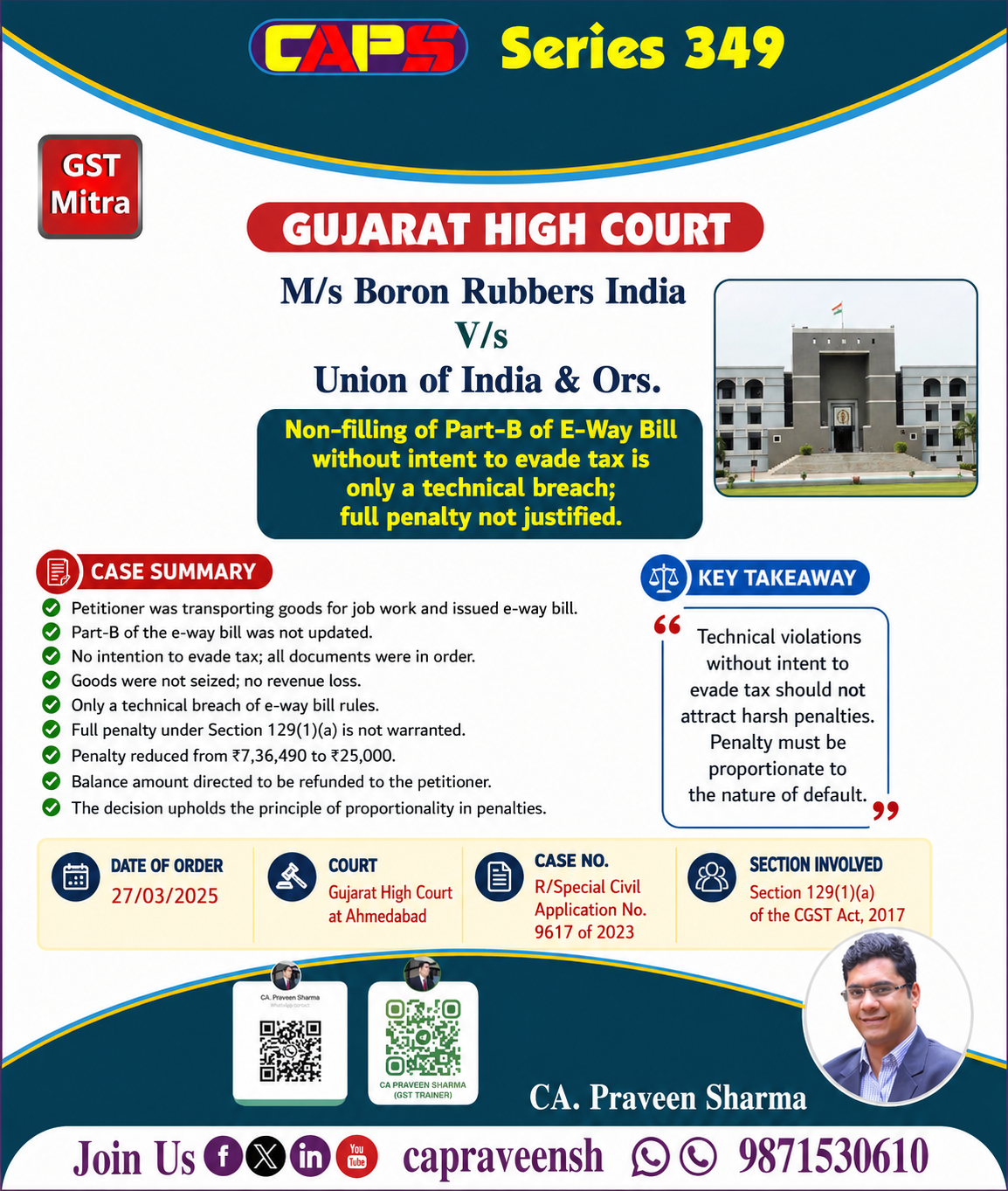
The Gujarat High Court has held that mere non-filling of Part-B of an E-Way Bill, without any intention to evade tax, is only a technical breach and does not justify the imposition of the maximum penalty under Section 129 of the CGST Act.
In the case of M/s Boron Rubbers India v. Union of India & Ors., the taxpayer had transported goods to a job worker under a delivery challan. While Part-A of the E-Way Bill had been duly generated, Part-B was inadvertently left blank. During transit, the goods were intercepted, and the authorities detained the consignment and imposed tax and penalty under Section 129(1)(a) of the CGST Act.
The taxpayer argued that the movement of goods was only for job work, there was no sale involved, and there was no intention to evade tax. The Gujarat High Court accepted this contention and observed that Part-A of the E-Way Bill already contained all the essential details of the transaction. The omission to fill Part-B was merely a procedural lapse.
The Court also relied on CBIC Circular No. 64/38/2018-GST dated 14 September 2018, which recognizes that certain E-Way Bill violations are technical in nature and should not automatically attract harsh penal consequences.
Holding that the penalty imposed was disproportionate, the Court reduced the penalty from ?7,36,490 to ?25,000 and directed the authorities to refund the balance amount recovered from the taxpayer.
The judgment reiterates that procedural lapses, in the absence of any intention to evade tax and where the transaction is genuine, should not result in excessive penalties under the GST law.
LINK:CA. Praveen Sharma on Linkedin
REGARDS
CAPS
0 Comments: